.jpg?ph=e9356020b3)
The Glogster/Wikispaces combo is a excellent way to build student writing portfolios. The excitement generated as the students create their Glogs is reason enough alone to utilize this great tool in the classroom. See the Wikispace here.

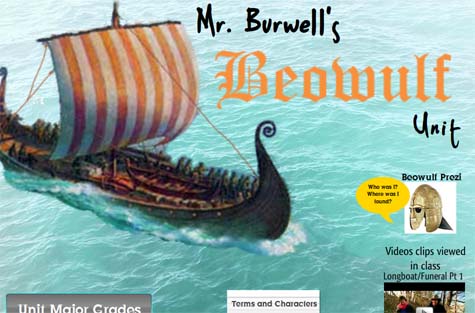
Glogster is a great way to set up a "virtual bulletin board" for teaching units. View my Beowulf unit here, which includes essential questions, study aids, and some fun student activities.
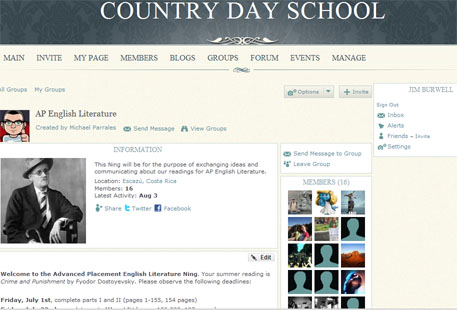
Using Ning.com to guide AP students and have them respond to required summer reading was extremely succesful. It kept the students on track and allowed them to bounce ideas off of each other.
This Ning is closed to public viewing. View the assignment prompt and sample responses here.
While studying Orwell's 1984, students were assigned a Video project to bring Orwell's 1984 to the year 2011. Students were encouraged to think about how the various ministries and the Brotherhood resistance of Orwell's novel might utilize the tools at their disposal in the world today, including social media like Twitter, Facebook, and Youtube; and technological innovations like cell phones and GPS. The assignment description and rubric can be viewed here.
What follows are examples of the student videos.
Integrating Technology in the Classroom
It is surprising how often educators still speak of how too much emphasis is being placed on technology, and how technology detracts from, rather than adds to, student learning. Given how ubiquitous computer applications have become in our society, I have become convinced that this mentality is more of a defense mechanism than the result of any rational thought process. It is clear to me that as educators and schools as a whole we lag far behind the students that we teach, and the workplace that we portend to prepare students for, in the area of technology. As a teacher, principal, and leader of professional development workshops I have been at times chagrined at the lack of proficiency demonstrated by some. The sad reality is that for teachers who are only beginning to move beyond email and word processing in using technology as a tool, it is perhaps already too late, as I believe we are still on the cusp of the information/communication revolution and the change will only accelerate in an exponential fashion in the coming years. Those who are still trying to catch up now may soon find it too late.
I have been an advocate of technology in the classroom since early on in my teaching career. In the late 1990’s, while working at Anacortes High School in Washington State, I applied for and was awarded a grant from the Bill and Melinda Gates Foundation for $10,000 worth of equipment in the classroom and 15 credits worth of training for the integration of technology in the classroom. My classroom was soon equipped with student computers, an LCD projector, and digital cameras. Students were designing websites, revising each others’ papers in Word, creating videos, and more. The interest that this engendered amongst the students was revelatory for me, and I have been an advocate of technology ever since.
At Colegio Interamericano in Guatemala, where I began as a high school English teacher and then went on to become high school principal, one of my highest priorities was to bring the school in to the 21st century with advancements in technology. Purchasing Edline as an online classroom portal and updating a very dated version of Administrator Plus, and then training the k-12 faculty in the use of Edline, I count among my achievements. In addition, I introduced a 1:1 laptop program in the High School and trained the faculty as to how to leverage the many opportunities for student learning which this provided. I built on this experience as a 12th grade English teacher at Country Day School in Costa Rica, already a 1:1 laptop school, by running a paperless classroom, taking advantage of the growing web based arsenal of exciting and interesting learning tools, and then participating in professional development to share with other teachers some of the opportunities available to them and skills that I had acquired. I share some of these tools and how I have applied them in the classroom here.
Search site
DMGLLHWCGGGB
ICC